


Internal Family Systems Therapy (IFS)
A different way of understanding what happens inside us.
What is IFS?
Have you ever noticed that different sides of you can want completely different things?
A part of you wants to say no, but another part feels guilty.
A part of you knows you're good enough, but another part doesn't believe it.
A part of you wants closeness, while another part wants to pull away.
Internal Family Systems (IFS) is a therapeutic approach developed by Dr Richard Schwartz that helps us make sense of these different sides of ourselves.
IFS suggests that rather than having one single way of thinking and feeling, our minds are naturally made up of different parts, or subpersonalities. These parts can have their own emotions, beliefs, fears and ways of responding.
You might recognise a part that overthinks, criticises, people-pleases or needs to get things right. Another part might become anxious, angry or overwhelmed. Another might want to shut down, avoid or escape what you're feeling.
Having parts doesn't mean there is something wrong with you. IFS sees this as a normal part of being human.
What becomes important is understanding why certain parts have taken on the roles they have — and what they may be trying to protect.
IFS starts from a simple idea: rather than fighting a reaction, we get curious about it.
If a part of you is constantly people-pleasing, for example, we wouldn't only focus on helping you say no. We might also become curious about why saying no feels so difficult.
What does that part think might happen?
Maybe it fears conflict. Rejection. Disappointing someone. Being seen as selfish.
When we begin looking underneath the behaviour, it often starts to make much more sense.
The different roles our parts can take on
Dr Schwartz describes some common roles that parts can take within our internal system.
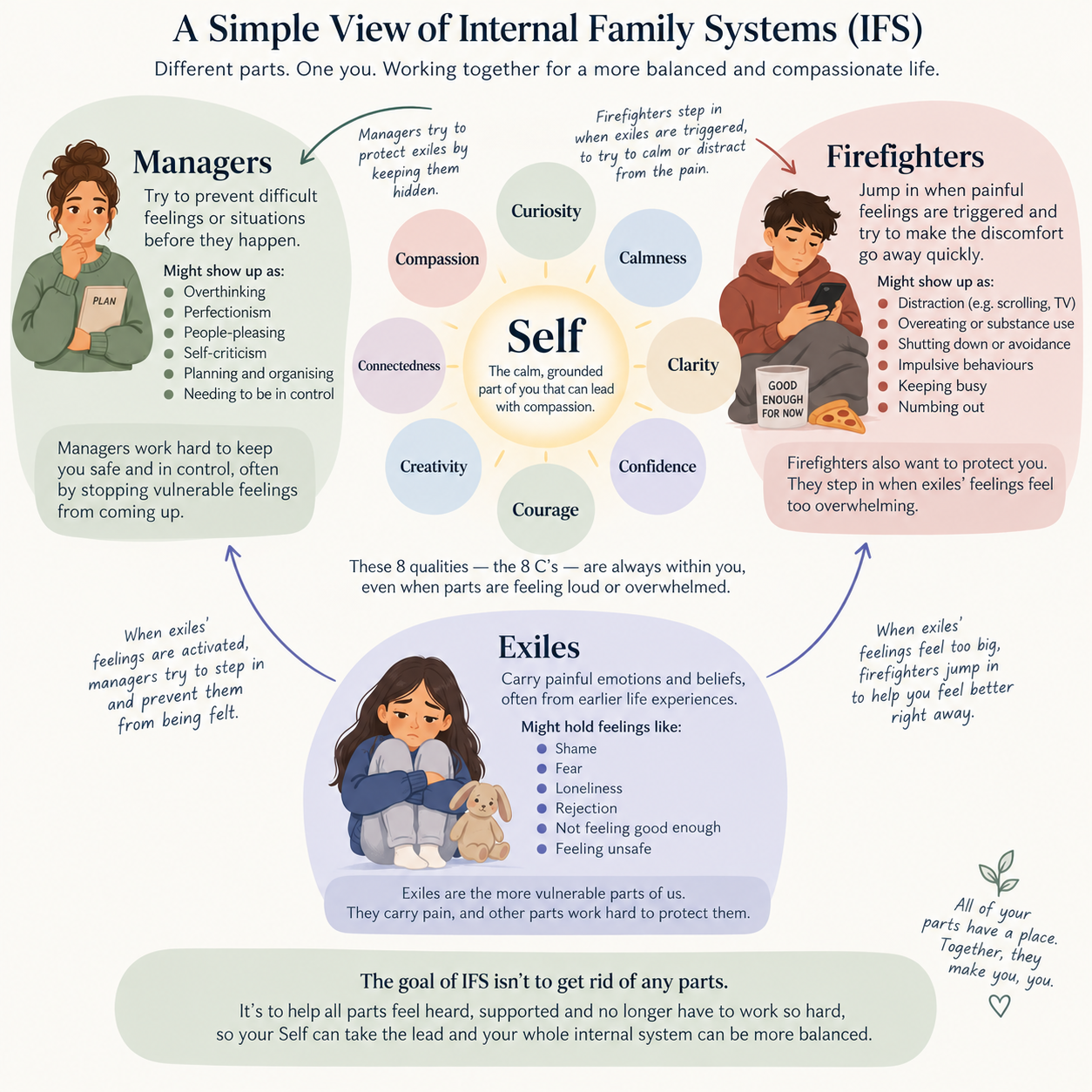
Managers try to prevent difficult feelings or experiences before they happen. They might do this through perfectionism, overthinking, people-pleasing, self-criticism, achievement or needing to stay in control.
Firefighters tend to step in once something painful has already been triggered. They want relief quickly, so they may push us towards distraction, avoidance, numbing, shutting down or other behaviours that help us escape what we're feeling.
Both are often trying to protect more vulnerable parts, known as Exiles. These parts may carry painful emotions and beliefs connected to earlier experiences — things like fear, shame, loneliness, rejection or “I'm not good enough.”
And then there is Self.
IFS proposes that underneath all of these different parts, we have a core Self with the capacity for qualities such as curiosity, compassion, calmness, clarity, confidence and connection.
Self isn't another part, and it isn't something you have to create or become. It's already there.
Sometimes, though, a part becomes so activated that it can feel as though it has completely taken over. IFS calls this blending.
Instead of being able to notice “a part of me feels like I'm not good enough,” it simply feels like:
“I'm not good enough.”
IFS helps us create some space between ourselves and these strong reactions so that we can become curious about them rather than being completely consumed by them.
As parts begin to feel heard and understood, they often don't need to work quite so hard. This can allow us to access and process the emotions, experiences and beliefs they've been protecting.
IFS refers to the process of releasing some of what a part has been carrying as unburdening.
The part doesn't disappear. It simply may no longer need to protect you in the same way.
How can IFS help?
You might come to therapy because you're anxious, overwhelmed, hard on yourself, struggling in relationships, repeating patterns you don't understand, or simply feeling that something isn't quite right.
IFS gives us a way to slow these experiences down and become curious about what's happening beneath them.
For example, you may notice that you become very anxious when someone is upset with you, but have no idea why. Rather than assuming you're “too sensitive” or simply trying to stop the anxiety, we can begin with the anxiety itself. What happens inside you? What does that part seem afraid of? What does it need you to know?
Sometimes this leads us to experiences or beliefs you already understand. Other times, we discover connections you hadn't recognised before.
And for people who do already have a lot of insight, IFS can help us go further. You may know exactly where a pattern comes from and still find that knowing hasn't changed how you feel or react. IFS allows us to work with the emotional experience underneath that understanding, rather than only talking about it.
Over time, parts that have been working hard to protect you can begin to feel safer and no longer need to respond quite so strongly. This can create more space between what you feel and how you respond — and more choice in how you relate to yourself, other people and the situations you find yourself in.
Putting it all together
If all of this feels like a lot to take in, this diagram offers a simple way of seeing how Managers, Firefighters, Exiles and Self fit together within the IFS model.
Common Questions about IFS
-
No. IFS sees having different parts or subpersonalities as a normal feature of the human mind.
Most of us already speak this way without thinking about it — “part of me wants to go, but part of me wants to stay.” IFS simply gives us a framework for understanding these different internal experiences.
-
Not at all.
You don't need to know the terminology or be able to identify Managers, Firefighters or Exiles.
You might come to therapy knowing you're anxious, stuck in the same relationship patterns, incredibly hard on yourself or overwhelmed by your emotions.
Or you might not know what's going on at all. You might simply know that something doesn't feel right.
We start there.
-
No. Understanding your parts is important, but IFS isn't an intellectual exercise.
You can know exactly where a pattern came from and still find yourself reacting in the same way.
The work is about moving beyond simply understanding your experiences to working with the emotions, beliefs and experiences underneath them.
The aim isn't just to understand yourself differently — it's for something to begin to feel different too.
-
No. One of the central ideas in IFS is that there are no bad parts.
A part can behave in a way that causes problems, but IFS becomes curious about what that behaviour is trying to achieve.
A harsh inner critic, for example, might believe that criticising you will stop you from failing or being rejected. Understanding its intention doesn't mean we have to like what it's doing — it gives us somewhere deeper to work from.
-
That's a really understandable response — especially when a part is causing distress or behaving in a way that you wish would stop.
You might hate the part that criticises you, becomes anxious, overeats, gets angry, shuts down or keeps pulling you into the same pattern.
IFS doesn't ask you to suddenly like that part or be grateful for what it's doing. Instead, we become curious about why it's there and what it believes it's doing for you.
Often, the parts we most want to get rid of are working incredibly hard to protect us in the only way they know how.
The aim isn't to get rid of the part. It's to help it no longer need to do its job in such an extreme way.
-
That's okay too.
IFS isn't about changing everything about you or taking away the parts of yourself that you value.
You might have an organised part, an ambitious part, a caring part or a part that helps you achieve — and genuinely like those qualities about yourself.
We're interested in whether a part has choice and flexibility, or whether it feels like it has to do its job.
For example, there's a difference between enjoying achievement and feeling that you must constantly achieve in order to feel worthy.
IFS isn't trying to take away what works. It's about helping parts step out of roles that have become exhausting, rigid or painful while keeping the qualities they bring to you.
-
You don't need to go looking for Self or somehow get yourself into the “right” state before we can do IFS.
In fact, thinking “I can't find my Self — I'm doing this wrong” may simply be another part showing up.
Sometimes Self is easier to access, and at other times our parts are understandably much louder. This is particularly true when something feels threatening, painful or overwhelming.
We work with whatever is there.
Self isn't something you need to create or achieve. In IFS, the understanding is that Self is already there, even when it feels difficult to access.
-
No. You don't need to sit there trying to find them.
Usually, we begin with something you're already experiencing.
Maybe you notice anxiety when you're talking about a relationship. You suddenly feel angry. Your chest tightens. You want to change the subject. You hear a thought saying “this is stupid.” Or you suddenly feel nothing at all.
That's where we become curious.
Parts don't necessarily appear as clear voices or characters in your mind. They can show up through thoughts, emotions, beliefs, body sensations, urges, images, memories or ways of responding.
You don't need to decide “this is definitely a part.” We can simply notice what's happening and explore it together.
-
This is a really common question, and IFS has a slightly different way of thinking about it.
Your parts are part of you. We're not trying to separate your personality into things that are “you” and things that aren't.
Parts are different aspects of your internal experience that may become more or less present at different times.
For example, you might feel confident and capable at work, then feel incredibly small or unsure of yourself during conflict with someone you love. Both experiences are yours — different parts of your system may simply be more activated in different situations.
Over time, you may become better at noticing “something in me is really afraid right now” rather than feeling that the fear represents all of who you are.
And you don't need to be able to do that before starting IFS. Learning to notice these differences is part of the work.
IFS Resources
Books
No Bad Parts
Richard Schwartz
A very accessible introduction to IFS and a great place to start.
View book →
You Are the One You’ve Been Waiting For
Richard Schwartz
Explores IFS in the context of relationships, intimacy and connection.
View book →
The Internal Family Systems Workbook
Richard Schwartz
A practical workbook for exploring your own parts and internal system.
View book →
Self-Therapy
Jay Earley
A step-by-step introduction to using IFS concepts for self-exploration.
View book →
Videos & Podcasts
Richard Schwartz: An Introduction to IFS
A simple introduction to the IFS model from its founder.
Watch →
Richard Schwartz: IFS Explained & Demonstrated:
Dr Richard Schwartz explains IFS and demonstrates the approach with Dr Rangan Chatterjee, allowing you to see what working with parts can look like in practice.
Watch →
Richard Schwartz on Internal Family Systems — Esalen
A longer conversation exploring IFS, parts and Self in more depth, including a demonstration of the approach.
Listen →